



Discover the latest insights on risks and global landscapes today.

Are you a new staff or student? Here’s a one-stop page with all the relevant documents and information you need to know.
To ensure that all NUS Policies, Procedures and Guidelines have a consistent format, are formally approved, officially registered and published, widely communicated and duly implemented, ORMC has developed various resources to assist individuals and groups involved in developing, amending or repealing University policy documents including:
Please contact policy@nus.edu.sg if you have any queries on the Policy Development Resources.
Learn how the official templates for Policy Documents should be used.
An amendment to a Policy can be in the form of:
A significant change to a Policy Document which:
Examples of Major Amendments may include (but are not limited to) the following:
An editorial, administrative or clerical amendment to a Policy Document which:
Any amendment that does not satisfy all of the elements listed above will, by default, be deemed a Major Amendment.
Examples of Minor Amendments may include (but are not limited to) the following:
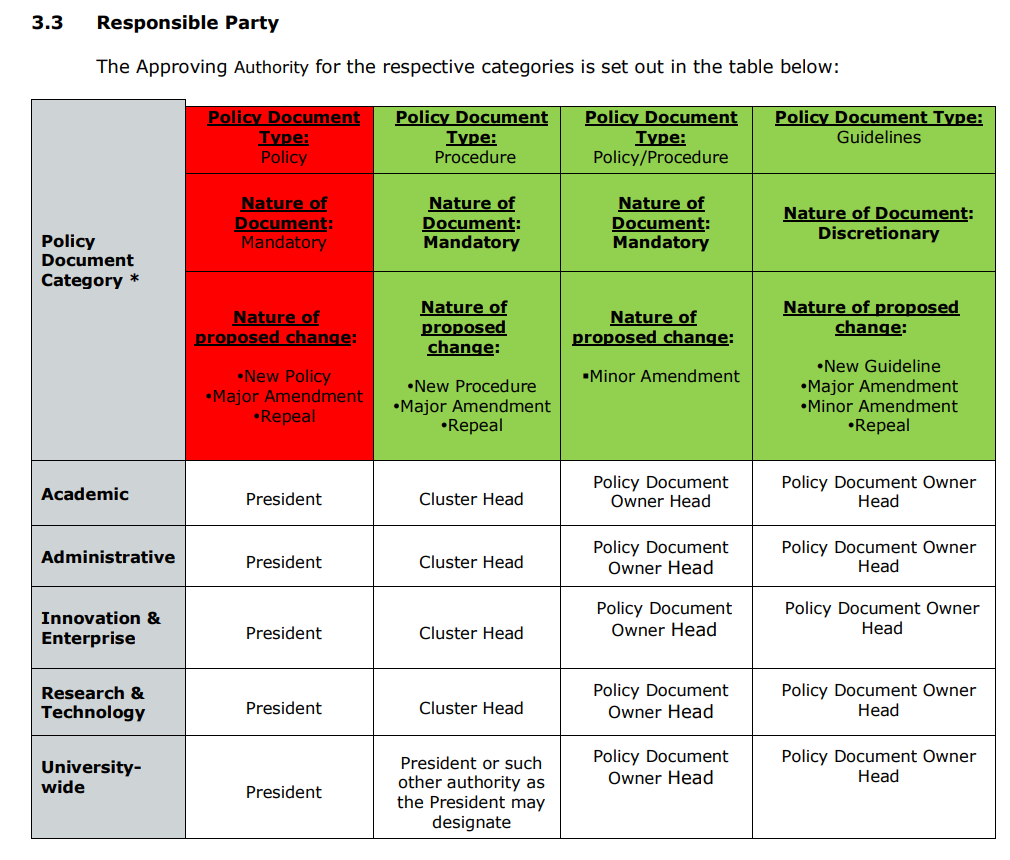
All changes to any Policy Documents require the approval form to be completed and signed by the relevant Approving Authority and Responsible Officer. The different types of changes are:
The Responsible Owner may submit one consolidated Approval Form for multiple Policy Documents if the Policy Documents are approved at the same time, by the same Approving Authority.
Note: An email approval is accepted as a replacement for the signature. Please forward the email approval together with the Policy Document during submission.
| Item | Description |
|---|---|
|
Short Summary |
Brief Description of the Policy Document which will be displayed on Policy Portal |
|
Approval Date |
dd/mm/yyyy |
|
Effective Date |
dd/mm/yyyy |
For Policy Owners / Initiators, get the step-by-step guide at the Policy Document Development Process page.